A wheelchair lift for home use carries the rider while they stay seated in their scooter, manual chair, or powerchair, so nobody has to transfer at the door. We install and service home wheelchair lifts across New Hampshire from our Salem and Meredith offices, indoors and out.


Accessibility standards call for one foot of ramp length for every inch of rise. Work that out on a real house and the problem becomes obvious.
A 36 inch rise needs 36 feet of ramp. A 48 inch rise needs 48 feet, plus a level landing at the top, plus turn platforms if the run has to switch back on itself to fit the lot. That is a structure running the length of a front yard.
A vertical platform lift covering the same 36 inch rise occupies roughly 12 to 16 square feet at the base. The ramp covering that rise occupies well over 100 square feet once landings are counted.
Thirty six feet of ramp is also thirty six feet of surface to shovel, sand, and keep clear of ice each winter. A lift gives you a small pad and a platform to clear instead.
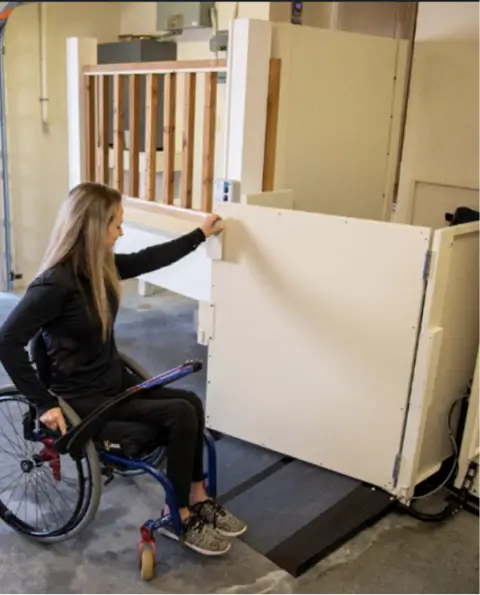
Mounting the lift beside a porch rather than in front of it keeps the walkway clear and shortens the electrical run.
Back decks on sloped lots often sit five or six feet above grade, which rules out a ramp entirely. A lift ties into the deck framing at the corner. For the two or three steps between an attached garage and the kitchen, a compact unit inside the garage bay uses the existing circuit and stays out of the weather.
Split level homes have short rises and tight landings, which is the worst combination for a ramp. A platform lift handles the half flight where nothing else will fit, and the same equipment covers interior floor to floor access where an elevator shaft is not workable.
Send us a photo of your entry and we will tell you what fits.
The Harmar Highlander II is the platform lift we install most often. It lifts users and mobility devices up to 14 feet, serving decks, porches, garages, and second storey entries.
Capacity is 750 pounds, which covers a powerchair, the rider, and a caregiver together. Five platform sizes are available:
Travel runs at 10.4 feet per minute on a sealed ACME screw drive, powered from a standard 120V AC supply with a 15 amp breaker.
Standard safety equipment includes a safety pan beneath the platform that halts travel on contact with an obstruction, an overspeed brake, door and gate interlocks that prevent movement while a gate is open, an emergency stop button on the platform, four LED status indicators, and a manual lowering tool for use during an outage. The unit is ETL listed and built to the ASME A18.1 safety standard, rated for residential and commercial use.
The optional ReadyUPS uninterruptible power supply activates automatically when the power drops and delivers a minimum of five complete up and down cycles depending on battery condition. In a state where winter storms take out power for a day at a time, this is the option we recommend most.
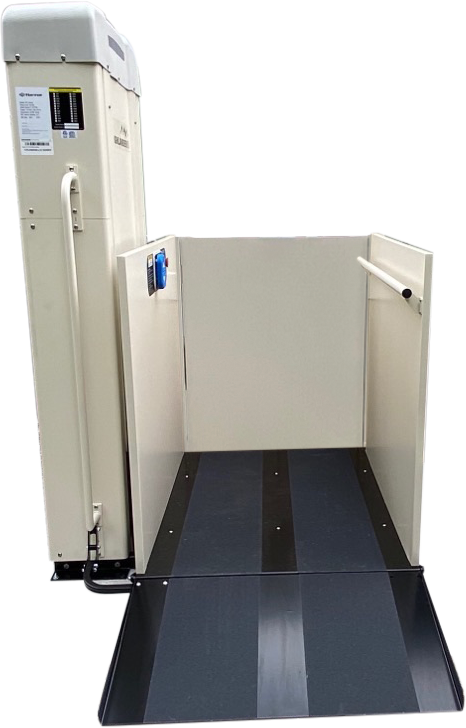
Outdoor units are finished in a Seal-Kor powder coat with stainless steel hardware, which keeps a lift working through New England freeze and thaw cycles, road salt, and moisture. Outdoor installations sit on a level concrete pad that drains away from the tower.
Enclosure kits and fire rated door options are available where local code or travel height calls for them. Indoor installations skip the pad and the weather entirely, which lowers the install cost and the long term maintenance load.
Almost certainly. With 750 pounds of capacity and five platform sizes up to 42 by 60 inches, the Highlander II accommodates most scooters, manual chairs, and powerchairs, along with a caregiver riding alongside.
The measurement to take is the length and width of the device with the footrests extended, plus turning clearance if the rider needs to turn on the platform rather than back off it.

Answers to your real estate questions and concerns.
dont worry we're free for consultation, just click button below.
It depends on the rise. Below roughly 12 inches a ramp is usually simpler and cheaper. Above that, ramps grow at a foot of length per inch of rise and quickly outgrow the yard, at which point a lift takes far less space and less winter maintenance.
Roughly 12 to 16 square feet at the base for the pad and tower, plus clearance for the rider to turn onto the platform and clearance at the upper landing.
With the ReadyUPS battery backup option, yes. It activates automatically and delivers a minimum of five complete up and down cycles depending on battery condition.
Yes. Outdoor units use a Seal-Kor powder coat finish with stainless steel hardware built for weather exposure, set on a level pad that drains away from the tower.
Original Medicare does not, because it classifies platform lifts as home modifications rather than durable medical equipment. Some Medicare Advantage plans include supplemental home modification benefits, and New Hampshire Medicaid waivers cover equipment for eligible participants.
Installed cost depends on travel height, platform size, indoor or outdoor placement, and the cost of any concrete pad and electrical work needed. We provide an itemized written quote after the free assessment.
We would advise against it. A platform lift carries a person and several hundred pounds of equipment several feet in the air, and the safety systems that make that acceptable are certified to the ASME A18.1 standard. A homemade unit carries no listing, no inspection, and no liability coverage.
Fully funded units are uncommon. The realistic routes are Medicaid waiver funding for eligible participants, disease specific foundation grants, and equipment reuse programs that place refurbished units at little or no cost.
We will measure the rise, check the pad location, and tell you which platform size suits your device. The assessment is free and carries no obligation.
Serving Salem, Derry, Londonderry, Nashua, Manchester, Concord, Meredith, Laconia, and surrounding New Hampshire communities.