Stair lift maintenance in New Hampshire runs on a different schedule than it does in a mild climate. The equipment is the same, and so is the manufacturer’s service interval, but the things that go wrong here cluster between November and March. Batteries lose capacity in the cold, road salt and sand get tracked onto the rail, and storms take the power out for a day at a stretch. None of it is dramatic alone, and all of it is easier to handle in October than in January.
Why Cold Weather Changes the Picture
Three things behave differently once the temperature drops.
Batteries lose usable capacity in the cold. A set that gave plenty of trips in August gives fewer in February, and a set already near the end of its life fails during the first hard cold snap rather than gradually.
Moisture arrives constantly. Boots carry snow onto the treads, it melts, and the water sits on the rail and around the carriage.
Grit comes with it. Sand and salt from walkways get tracked indoors and settle on the rail. On a greased rail that mixture turns into an abrasive paste, and on a grease-free rail it still collects and needs clearing.
The Pre-Season Checklist
Running through this in October or early November costs an hour and heads off most winter service calls.
Battery Condition
Note how the lift behaves on a full charge. If it travels more slowly toward the end of a trip, or an indicator takes longer to clear than it used to, the batteries are near the end and will not improve once it gets cold.
Batteries typically last three to five years. If yours are inside that window and showing either sign, replace them before winter rather than waiting for a failure on a cold morning.
Charge Points at Both Ends
Confirm the carriage charges at both park positions. Park it at the top, leave it an hour, then check the indicator, and do the same at the bottom. A charge point that has quietly stopped working will not announce itself until the batteries drain.
While you are there, check the outlet is live and that nothing was unplugged to make room for a seasonal appliance.
Rail & Carriage Cleaning
Wipe the full length of the rail. On a grease-free rail a dry cloth or a vacuum does the job. On a greased rail, follow the owner’s manual rather than improvising, since the wrong solvent strips lubricant the drive needs.
Look at the underside of the carriage where it meets the rail, since that is where grit accumulates first.
Safety Function Test
Run the lift through its full travel and check each function. The seatbelt should latch and release cleanly, the obstruction sensors should stop travel when something contacts the footrest, the emergency stop should halt the carriage, and the call controls should work from both landings.
Anything that fails here is a service call, not a repair to attempt yourself.
What to Watch Through the Season
Keep the Stairs Clear
The most common winter fault is not a fault at all. An obstruction sensor stops travel when a boot, a glove, a stair rod, or a loose carpet edge contacts the carriage, and clearing the rail resolves most of these.
If the lift stops in the same spot repeatedly with nothing in the way, that is a sensor or rail alignment issue and it needs a technician.
Park It on the Charge Point Every Time
This is the one piece of maintenance the owner fully controls, and it does more for battery life than anything a technician does. Batteries drain steadily when the carriage sits mid-rail, and in cold conditions they drain faster. A continuous beep usually means exactly this, and parking the carriage properly generally clears it.
Listen for Changes
A new noise matters more than a loud one. Grinding, clicking, or a sound that was not there last month suggests something mechanical rather than electrical, and so does hesitation at the same point on every trip. Take the lift out of use until it has been looked at, particularly where the rider cannot manage the stairs unaided.
Outdoor Units Need More
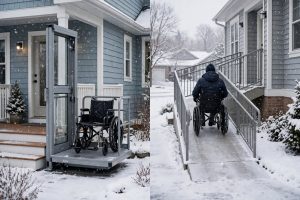
An outdoor stair lift serving porch or deck steps carries the same checklist plus items of its own.
Clear snow and ice from the rail and treads before anyone rides. A carriage traveling through packed snow loads the drive in a way it was not designed for.
Keep the protective cover on when the lift is parked and confirm it still seals. A cover that has stiffened or split lets meltwater into components sealed against spray rather than standing water.
Check the fasteners and the finish at both ends of the season, since corrosion starts at the hardware rather than the painted surfaces.
Outdoor units generally need twice-yearly professional service rather than annual, with one visit before winter and one after.
Power Outages
Battery operation is the reason a stair lift keeps working when the grid goes down, and in a state where winter storms routinely take out overhead lines for a day, that matters.
Published figures vary by model and source, with manufacturers citing up to 60 up and down cycles and many dealers quoting around 40 as the conservative number. Plan around the lower figure.
Two habits make that reserve useful. Park the carriage on a charge point so the batteries are full when an outage starts, and learn the manual lowering procedure before you need it. Have a family member learn it too, since the person who operates it is often the one standing at the bottom of the stairs.
Booking the Professional Visit
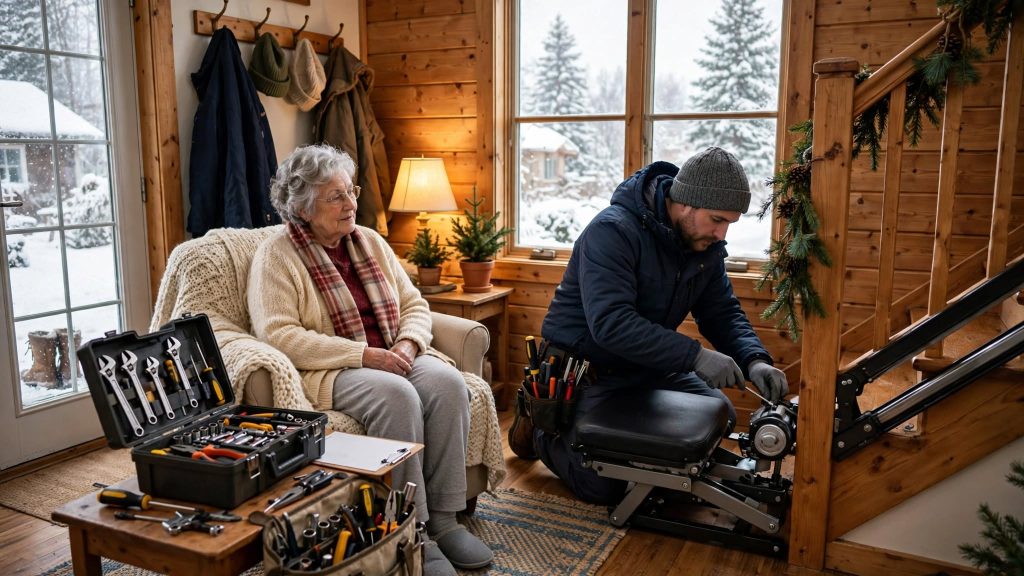
A preventative visit covers the rail brackets and alignment, battery health and both charge points, the obstruction sensors and seatbelt, swivel and footrest function, the controls at the seat and both landings, and lubrication where the model calls for it.
An annual visit suits a standard indoor household with one rider. Move to twice yearly for heavy use, two or more riders, curved rails, or any outdoor installation.
Book it before the season rather than during it. Service schedules fill up once the cold arrives, and the whole point of a preventative visit is that it finds the worn battery in October rather than leaving someone stuck upstairs in February.