Most people start looking at accessibility equipment before they know what they are looking for. Something has changed, a fall or a diagnosis or a slow decline nobody wanted to name, and the stairs have become the problem. Product catalogs are unhelpful at that stage, because they assume you already know which category you need.
A better starting point is the barrier itself. Work out exactly where the difficulty happens and the equipment narrows itself down quickly.
Mapping the Barriers in Your Home
Walk the route the person actually takes on an ordinary day. Not the tour of the house, the real route. Bedroom to bathroom. Bedroom to kitchen. Kitchen to the car. Wherever they sit in the evening and back again.
Note every point where they stop, hold onto something, ask for help, or avoid going altogether. Avoidance is the signal people miss most often. Someone who has quietly stopped going down to the basement laundry or out to the back deck has already told you where the barrier is, without saying so.
Cover these specifically:
- Entry steps. Front, back, and the garage door, since the one they use most may not be the one visitors use.
- Interior stairs. Full flights and the half flights in split level homes.
- Door sills, the step down into a sunken room, sliding door tracks.
- Bathroom access. Doorway width, the tub or shower edge, toilet height.
Write it down. A written list keeps the conversation about facts instead of about someone’s pride.
Equipment for Stairs
Stair Lifts
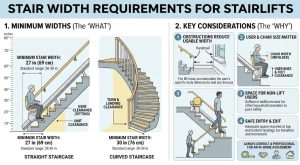
A seated rider travels the staircase on a rail mounted to the treads. This is the least invasive option by a wide margin, installs in hours on a straight run, and leaves the stairs fully usable for everyone else.
It suits someone who can walk short distances, can transfer on and off a seat, and finds the climb itself the difficulty. It does not suit a full time wheelchair user unless a second chair is kept on the upper floor, since the rider has to leave their chair at the bottom.
Residential Elevators
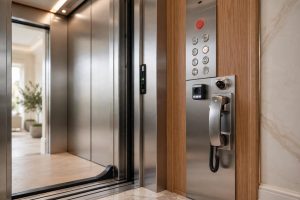
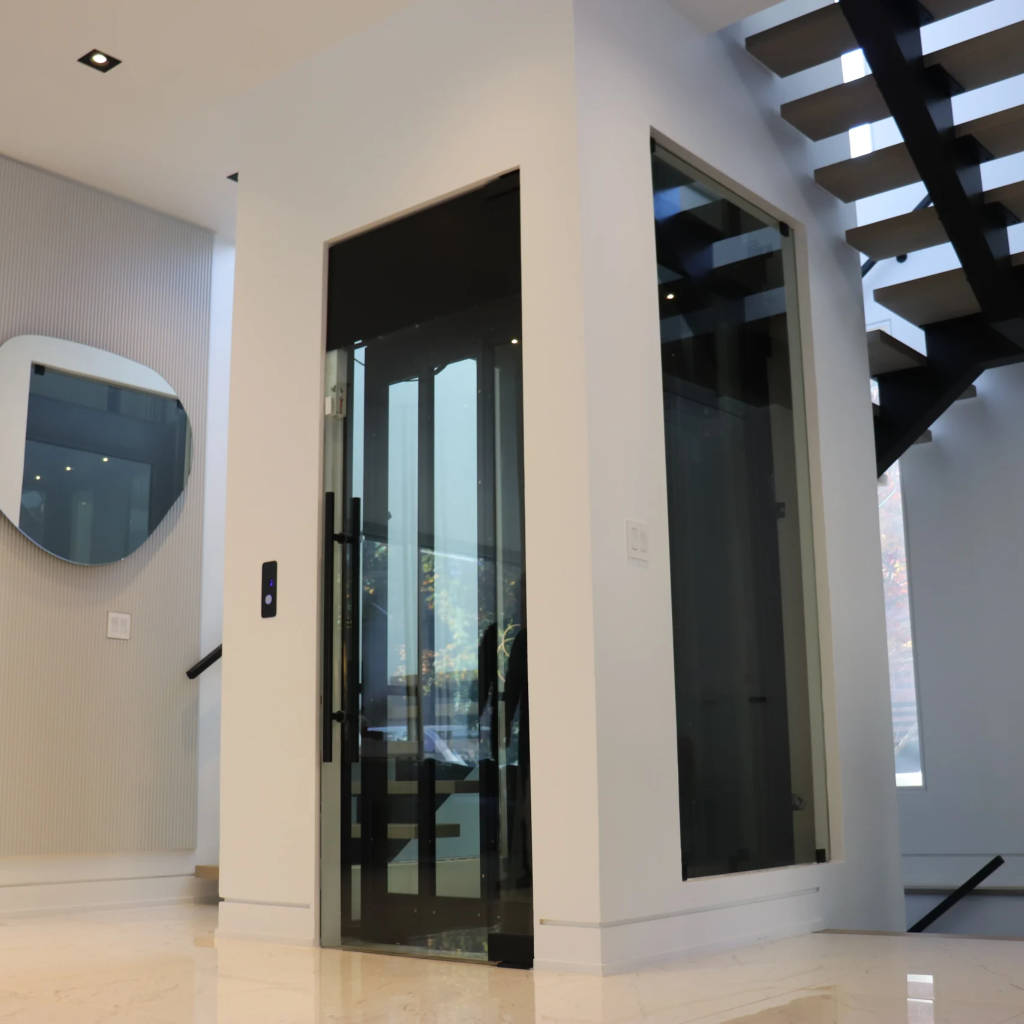
A cab travels between floors carrying the person, their mobility device, a caregiver, and whatever they are bringing with them. Traditional units serve up to six floors, and shaftless models connect two levels without a framed hoistway.
This is the option for full time wheelchair users, homes with three or more levels, and anyone planning for the next fifteen years rather than the next two. It requires construction, a permit, and a project timeline measured in months.
Vertical Platform Lifts
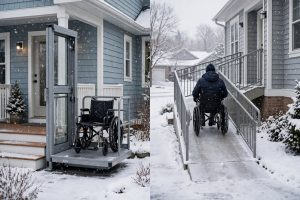
An open platform rises on a tower, carrying a rider who stays seated in their scooter or chair. Capacity is commonly 750 pounds with travel up to 14 feet, and units work indoors and out.
It fits where a ramp will not, at porches and decks, and it handles short interior rises in split level homes. It costs less than an elevator and takes less construction, while giving a wheelchair user what a stair lift cannot.
Equipment for Entries & Thresholds
Not every barrier needs a lift. The entry equipment scales with the height of the rise.
Threshold ramps handle a single step or a door sill, usually up to about six inches. They are portable, need no installation, and cost very little.
Modular ramps cover several steps. The constraint is the slope rule, which calls for a foot of ramp length per inch of rise. A 30 inch rise needs 30 feet of ramp plus a landing, which many yards cannot give up.
Platform lifts take over where the ramp math stops working, generally above a rise of two or three feet.
Grab rails & handrails address the cases where the difficulty is balance rather than height. A second handrail on a staircase, a grab rail beside an entry door, and better lighting at both ends solve more problems than people expect, for a fraction of the cost of anything mechanical.
Matching Equipment to the Mobility Device
The device someone uses is the fastest way to narrow the options.
Walking unaided but tiring easily. A stair lift covers stairs. Handrails and lighting cover the rest.
Cane or walker. A stair lift still works, provided the person can transfer onto the seat and a second walker is kept upstairs. Plan for where the walker lives at each end of the trip.
Manual wheelchair. This is the dividing line. A stair lift requires transferring out of the chair at the bottom and into a second chair at the top, which works for some households and is impractical for many. A platform lift or an elevator removes the transfer entirely.
Powerchair or scooter. A stair lift is not a realistic option. Powerchairs are heavy, expensive, and difficult to keep in duplicate. A platform lift or an elevator is the route.
The point at which a seated stair lift stops working and a platform lift starts is the transfer. If transferring is unsafe, unreliable, or exhausting, the equipment needs to carry the device as well as the person.
Planning Room by Room
Doing everything at once is rarely necessary and rarely affordable. A workable order looks like this.
First, the bathroom. Wet surfaces and hard edges make this the highest risk room in the house, and grab bars and a shower seat cost a few hundred dollars installed.
Second, the entry. If someone cannot get out of the house, everything else is secondary. Start with a threshold ramp or handrails and move up only if the rise demands it.
Third, movement between floors. This is the largest expense and the one with the longest lead time, which is why it benefits from being planned rather than rushed.
Fourth, the small fixes. Lever handles, rocker switches, brighter stair lighting, removing loose rugs, and marking the top and bottom step with a contrasting edge.
What Requires Construction & What Does Not
Knowing which side a piece of equipment falls on changes the timeline completely.
No remodeling needed. Stair lifts mount to the treads and need no permit in most towns. Threshold ramps sit in place. Grab bars, handrails, lever handles, and lighting are straightforward fittings.
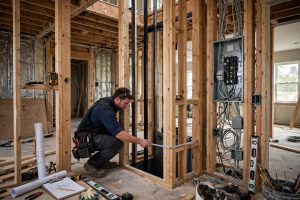
Construction, permit, & a contractor. Residential elevators need a shaft, a pit, overhead clearance, drawings, a permit, and an inspection. Platform lifts need a concrete pad, a dedicated circuit, and usually a permit. Doorway widening and curbless shower conversions involve framing and trades.
The practical implication is scheduling. The first group can be arranged in weeks. The second group takes months, which is the argument for starting the conversation before a hospital discharge date forces it.
If you are not sure which category your situation falls into, a free home assessment will map it out against the actual house rather than a general checklist. Start with the stair lift, residential elevator, and vertical platform lift pages to see what each one asks of a home.
Frequently Asked Questions
How to make your home ADA accessible?
The ADA governs public accommodations rather than private homes, so a residence is never legally required to comply. The standards are still a useful reference, particularly the 1:12 ramp slope rule and 32 inches of clear doorway width. Apply them where they help and ignore them where they do not fit the household.
What is the new mobility device for seniors?
Newer options include powered exoskeleton assist devices, smart rollators with sensors and braking assistance, and stand assist lift chairs. None of them solve a staircase. For getting between floors, the established categories of stair lift, platform lift, and residential elevator remain the practical answers.
What are the 4 types of accessibility?
Accessibility is commonly grouped into physical, sensory, cognitive, and communication categories. Home modification work sits mostly in the physical category, though lighting and contrast address sensory needs, and clear labeling and consistent layouts help cognitive ones.
What are alternatives to home lifts?
Relocating a bedroom and bathroom to the ground floor is the main structural alternative and often the cheapest. Others include converting a ground floor room, adding a small ground floor addition, or moving to a single level home. Each is worth pricing against a lift before assuming equipment is the only route.