Residential elevators carry people several feet in the air inside an enclosed shaft, and the systems making that acceptable are layered rather than singular. No one component is the safety feature. The interlocks, sensors, controls, brakes, and emergency equipment each cover a different failure, designed so the loss of any one does not put a rider at risk.
Doors & Interlocks
What an Interlock Does
The door interlock is the most important safety device on any elevator. It combines a mechanical lock with an electrical switch.
The mechanical half keeps the landing door locked unless the cab is present at that landing. The electrical half prevents the cab moving unless the door is confirmed closed and locked. Both conditions have to be satisfied before anything happens.
That covers the scenario people worry about most, which is a door opening onto an empty shaft. Interlocks on residential elevators are listed to CSA or UL standards, and every landing gets one.
Door Types & What Changes
Manual swing doors at the landings paired with accordion cab doors are the simplest arrangement, and the interlock still governs movement. Sliding cab doors with swing landing doors sit in the middle. Fully automatic sliding doors at both the cab and the landings are the most accessible, because nobody has to pull a door while managing a mobility device.
The safety logic is the same across all three. What changes is how much physical effort the rider supplies, which matters for a wheelchair user travelling alone.
Light Curtains & Door Sensors
Automatic door systems add an infrared light curtain across the opening. Anything breaking a beam stops the door closing and reverses it.
This covers hands, trailing clothing, and the footplate of a wheelchair partway through the opening. It works on presence rather than pressure, so nothing has to be squeezed before the door responds.
Controls Inside the Cab & at the Landings
Constant Pressure & Momentary Controls
Residential elevators generally use momentary controls, meaning the rider presses a floor button once and the cab travels to that landing. Platform lifts use constant pressure controls that stop the moment the button is released.
The difference reflects the enclosure. An elevator cab is fully enclosed with interlocked doors, so continuous input is not needed to keep the rider safe.
Control Placement & Usability
Cab controls should sit at a height a seated rider can reach, and a handrail with integrated controls makes that easier. Tactile and illuminated buttons help riders with limited vision.
Landing call buttons at each floor let someone send or call the cab. Where the rider cannot reliably manage a phone, controls at every landing are a safety matter rather than a convenience.
Key Switches
A key lock on the controls prevents unsupervised operation. In households with visiting grandchildren, this is worth specifying rather than treating as optional.
Sensors & Monitoring
Modern residential elevators carry sensors well beyond the door system. Position sensors confirm where the cab actually sits in the shaft. Overload sensors prevent travel when rated capacity is exceeded. Slack rope or slack chain sensors detect a loss of tension in the suspension and stop the system.
Many units include an in-cab diagnostic display showing fault codes. Its practical value is that a technician arrives knowing what the unit reported rather than starting from a phone description.
Braking & Overspeed Protection
The Safety Brake
Every residential elevator carries a mechanical safety brake independent of the drive. On traction and cable systems this is a set of safeties on the car sling gripping the guide rails. Activation is mechanical, so a power failure or controller fault does not disable it.
Overspeed Governors
The governor is a mechanical device that senses cab speed directly. If the cab exceeds a set speed, the governor trips and engages the safeties. It is not electronic and does not depend on the control system functioning.
Buffers in the Pit
Buffers sit at the bottom of the shaft as the final layer, absorbing impact if a cab reaches the pit under abnormal conditions. They are part of why pit depth is specified the way it is.
Emergency Systems
Two Way Communication
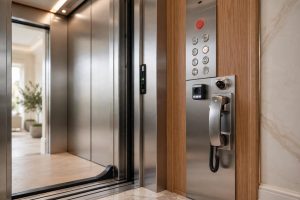
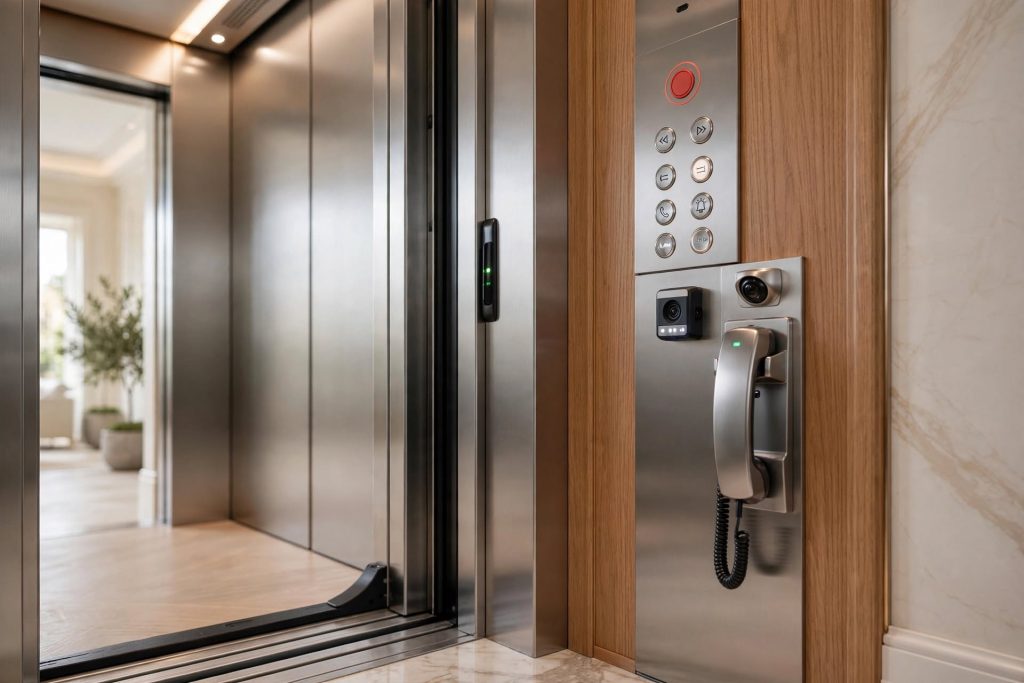
Code requires a means of two way communication inside the cab that works during a power outage, either a phone line or a cellular device.
Test it at handover and periodically afterward. A communication device that has quietly stopped working is a problem nobody discovers until it matters.
Battery Lowering
Battery lowering brings the cab to the nearest landing and opens the doors when power fails, rather than leaving a rider in a stopped cab. The battery also powers the cab light and communication device during the outage. Ask to see it demonstrated at handover, then operate it yourself before the crew leaves.
Emergency Stop & Alarm
An emergency stop inside the cab halts travel. An alarm button sounds audibly outside the shaft so someone elsewhere in the house knows there is a problem.
Manual Lowering
Where battery lowering is unavailable or has itself failed, a manual procedure lets someone outside the cab bring it down under control. This belongs in the owner’s manual and should be shown to a family member, not only the rider.
Inspection & Keeping the Systems Working
None of this stays reliable without attention. The applicable code is ASME A17.1, and local jurisdictions enforce it through permits and inspection before a unit can be used. Some states route residential elevator inspection to a state elevator division rather than the local building department.
A preventative maintenance visit covers interlocks at every landing, the governor and safeties, leveling accuracy, battery condition, the communication device, and door sensors. Annual service is the normal interval.
The failure mode worth avoiding is the slow one. Interlocks wear, batteries age, and communication devices get disconnected when a phone line is cancelled. None of those announce themselves.
Ask any installer to walk a family member through the emergency systems at handover, not just the rider. The person who needs to use the manual lowering procedure is usually the one standing outside the cab.