A curved stair lift installs on any staircase that turns, has a landing, has pie-shaped winder treads, or spirals. Most installations land between $9,000 and $20,000, and a traditional custom rail takes 4 to 8 weeks to manufacture before anyone can install it.
Those two facts drive almost every decision that follows. Here is what sits behind them, and how to keep the number at the low end of the range.
First, Confirm You Actually Need a Curved Lift
Dealers get this wrong in both directions, so check it yourself.
You need a curved rail if your staircase has:
- A 90-degree or 180-degree turn
- An intermediate landing between two flights
- Winder or pie-shaped treads at a corner
- A spiral configuration
- A need to park the chair around a corner at the top or bottom, out of the walking path
You may not need one if:
your staircase runs straight from floor to floor with no turn. In that case a straight stair lift costs a fraction as much and often installs the same day, because the rail is stock aluminum cut to length rather than built to order.
One edge case is worth knowing about. If your stairs have an intermediate landing with real standing room, some people can use two straight lifts instead of one curved unit and walk across the landing between them. It saves money. It also requires the user to stand, turn, walk, and sit down again on every single trip, twice a day, for years. For a user with balance issues, cognitive decline, or a progressive condition, that trade is a bad one. Have an assessor evaluate it honestly rather than pitching it as a discount.
Why a Curved Rail Costs What It Does
The chair on a curved lift is only marginally more expensive than the chair on a straight one. The rail is where the money goes.
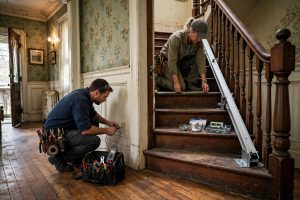
Your installer measures the staircase with a calibrated camera kit or 3D measuring jig, capturing rise, run, tread depth, and the exact geometry of every turn and landing. That data goes to a factory, which bends and welds each rail section to your staircase specifically. It is built once, for one house, and it will never fit another one.
That process is what adds several thousand dollars over a straight installation, and it is also what buys you a smooth ride through the turns instead of a jolt at every joint.
Installation labor reflects the same complexity. Straight installs commonly run a few hours. Curved installs add hours for multi-section rail joining, torque calibration on the bends, and alignment checks at each turn.
Realistic 2026 Cost Ranges
- Basic curved lift, single 90-degree turn, short run: roughly $9,000 to $13,000 installed
- Typical curved lift, one bend plus a landing, average staircase: roughly $12,000 to $18,000 installed
- Complex geometry, multiple turns, long run, or premium features: $18,000 and up
- Outdoor curved lift: add roughly $800 to $2,000 over the equivalent indoor unit for weather-rated components
Common add-ons and what they run:
- Power swivel seat: several hundred dollars, and the single upgrade most worth paying for. It rotates the seat at the top landing so you step off facing away from the stairs.
- Battery backup: a few hundred dollars. In New Hampshire, treat this as standard, not optional.
- Additional rail complexity, extra turns, or overrun sections to park the chair around a corner: $1,000 to $5,000 depending on the design
- New electrical outlet near the rail: a few hundred dollars if one is not already in place
- Removal and disposal of an existing lift: quoted separately
- Installation on concrete, tile, or steel stairs: a surcharge on most models
Ask every dealer for the turnkey installed number. Equipment-only quotes look attractive and then grow.
The Lead Time Problem, and the Way Around It
Standard curved rail manufacturing runs 4 to 8 weeks from final measurement to install day. That timeline is fine when you are planning ahead. It is a serious problem when someone is being discharged from a hospital or rehab facility next week and cannot reach their bedroom.
There are two ways to solve a curved staircase, and the right one depends on how much time you have.
Custom welded rail
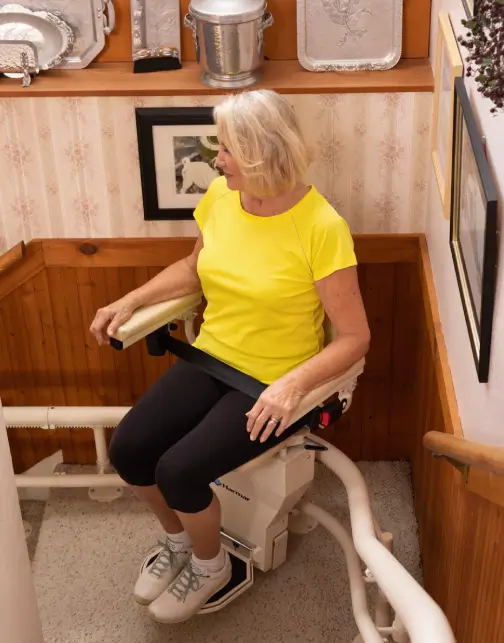
The Harmar Helix is built this way. The rail is measured with a calibrated camera kit and welded to your staircase geometry, with a 350 pound weight capacity, a folded width of roughly 16 inches so the stairs stay usable for everyone else, and a swivel seat for entry and exit at the upper landing. It handles 90-degree turns, 180-degree turns, tighter spirals, and multi-story runs. This is the choice when you have the weeks and you want the smoothest ride and the highest capacity.
Modular rail
The Harmar UP stairlift uses a modular rail system configured from standard components rather than welded to order. Rail drawings get completed on site during the first dealer visit, and installation can happen as soon as the next day. Weight capacity is 275 pounds, and it includes automatic folding footrests and automatic seat swivel at both landings. This is the choice when a discharge date is driving the schedule and waiting six weeks is not an option.
Most companies only offer the first option and quietly let you wait. Ask about both.
What to Check Before You Sign
- Dual-rail versus single-track. Single-track is lighter and cheaper. Dual-rail is steadier and better suited to heavier users and complex geometry. Ask which one is quoted.
- Weight capacity against real-world use. Rated capacity should have margin over the user’s weight, not match it.
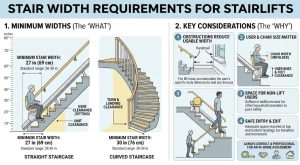
- Folded width. A narrow older New England staircase needs the chair to fold tight so other household members can still use the stairs.
- Which side the rail mounts on. This follows the user’s stronger side and the direction of exit at the top, not the installer’s preference.
- Swivel and footrest operation. Manual is fine for a strong user. Powered matters when grip strength or reach is limited.
- Warranty split. Manufacturer coverage on components and dealer coverage on labor are two different things. Get both in writing.
- Service plan. These are mechanical units with batteries, safety sensors, and a drive system. Annual service is what keeps a lift running past year eight.
Skip the Used Curved Lift
Refurbished straight lifts are a legitimate way to save money. Refurbished curved lifts usually are not.
The rail was built for one staircase. Buying a used curved unit means either finding a house with the same geometry, which effectively does not happen, or paying to have the rail reworked, which erases the savings and voids most warranty coverage. Most reputable dealers will not sell a used curved rail at all, and that is the correct answer rather than a limitation.
Ways to Bring the Cost Down
Medicare does not pay for stair lifts. Neither does standard homeowners insurance. What can help:
- VA benefits. The Home Improvements and Structural Alterations benefit covers medically necessary modifications, with a higher lifetime tier for service-connected disabilities and for non-service-connected disabilities where the veteran has a service-connected rating of 50 percent or more. It requires documented medical necessity and runs through your VA medical center.
- New Hampshire Medicaid. The Choices for Independence waiver covers home modifications for adults who meet the financial and functional criteria. Approval commonly takes three months or more, so start the paperwork before you need the lift.
- Granite State Independent Living. GSIL helps New Hampshire residents plan accessibility projects and identify funding sources.
- Monthly payments. Stair lift financing is how most families handle a curved installation, and the monthly figure is worth comparing against the cost of moving or of assisted living before you rule the project out.
Frequently Asked Questions
How much does a curved stair lift cost?
Most installations run $9,000 to $20,000 fully installed, with the average landing in the low-to-mid teens. Staircase length, number of turns, and added features set your position in that range.
Why is a curved stair lift so much more expensive than a straight one?
The rail. A straight rail is stock material cut to length. A curved rail is measured, bent, and welded to your specific staircase, which adds several thousand dollars in fabrication plus additional installation labor.
How long does a curved stair lift take to install?
Custom rails take 4 to 8 weeks to manufacture, then install in about a day. Modular curved systems can be configured on site and installed as quickly as the next day.
Can a stair lift fit a spiral staircase?
Frequently yes, with a custom rail. The limiting factor is the staircase construction. Spiral stairs built around a single center pole generally cannot accept a curved lift, so this needs an on-site evaluation rather than a phone answer.
Can I use two straight stair lifts instead of one curved lift?
Sometimes, if there is a real landing with room to stand and turn safely, and the user can stand and transfer without help every trip. For many users that is not safe, and a single curved rail is the better long-term answer.
Does Medicare cover a curved stair lift?
No. Medicaid waiver programs, VA benefits, and nonprofit assistance are the routes that apply, along with financing.
Do curved stair lifts damage the stairs?
No. The rail mounts to the treads, not the wall, using brackets. Mounting points are patchable if the lift is ever removed, and the staircase structure is untouched.
Can I get a used curved stair lift?
Realistically, no. The rail is built for one staircase and rarely fits another. Used inventory is limited to straight rail models.
Get Your Staircase Measured
Every number above becomes a firm figure once someone puts a measuring kit on your actual stairs and counts the actual turns. Stair Lifts & Ramps of New England is a family-owned company serving homeowners across New Hampshire from Salem and the Lakes Region, and the in-home assessment is free with no obligation.
Call 603-893-1523 or book your free in-home measure for a turnkey written quote, a straight answer on custom versus modular rail for your timeline, and a review of the funding programs you qualify for.