If you are researching a wheelchair lift for home use, you are usually solving one of two problems: getting in the front door, or getting to a floor that a ramp cannot reach. Both come down to one measurement. Grab a tape measure and get the total rise, meaning the vertical distance from the ground or lower floor to the surface you need to reach. That single number decides most of what follows.
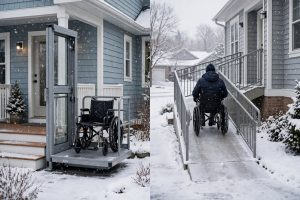
A wheelchair lift, also called a vertical platform lift or VPL, carries a person and their mobility device straight up. No transferring out of the chair, no long approach run, no rebuilding the yard.
The Rise Measurement That Decides Everything
Accessible ramp slope calls for roughly 12 inches of ramp for every 1 inch of rise. Run the math on your own entrance:
- A 10-inch rise needs about 10 feet of ramp. A ramp usually wins here.
- A 24-inch rise needs about 24 feet plus landings. Now you are eating a driveway or a front yard.
- A 48-inch rise needs roughly 48 feet with switchbacks and intermediate landings. Most residential lots cannot absorb that.
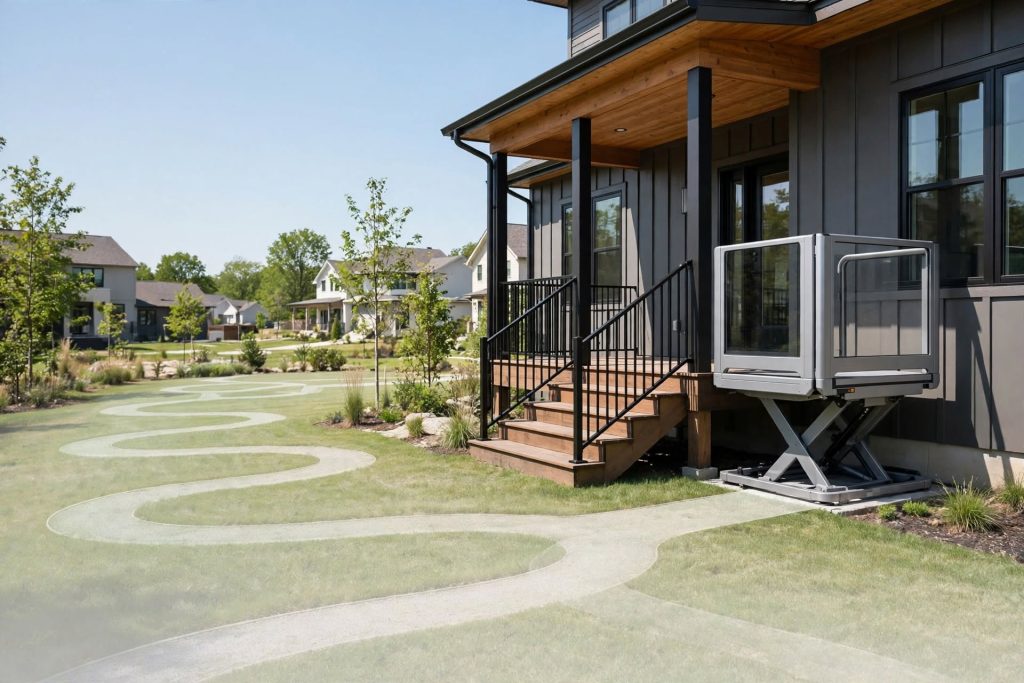
A wheelchair lift for home handles that same 48-inch rise inside a footprint of a few square feet. That is the entire reason the product exists. Where the yard has room and the rise is small, wheelchair ramps are cheaper and simpler. Once the rise passes roughly 30 inches, the lift usually costs less than the ramp it replaces once you count materials, framing labor, and lost yard.
When a Wheelchair Lift Is the Right Call
Choose a wheelchair lift if:
- The user cannot safely transfer out of the chair without help
- The rise is more than a few steps and the lot has no room for a compliant ramp
- The access point is a porch, deck, garage step, or split-level landing
- You need one level change, not full multi-floor access
Choose something else if:
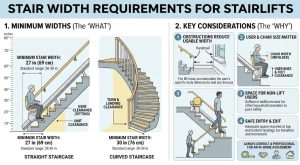
- The user can stand and transfer into a seat and the barrier is an interior staircase. A stair lift costs less, installs in hours, and requires no site prep.
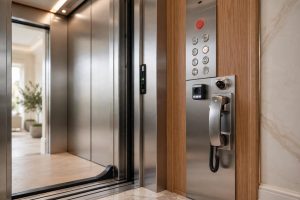
- You need to serve two or three floors with room for a wheelchair plus a companion, groceries, and laundry. That is a residential elevator, and it is the only option here that reliably adds resale value.
Specs You Need to Confirm Before You Sign Anything
Any quote that does not address these five items is incomplete.
Travel height
Residential vertical platform lifts commonly serve rises from about 4 feet up to 12 or 14 feet. Travel height is the biggest driver of price: taller means more tower, a stronger drive mechanism, and a more involved installation. Measure the rise before you shop models.
Weight capacity
Standard residential capacity runs around 750 pounds, which covers a power wheelchair plus the user with margin. If the user has a heavy power chair or needs a standing attendant on the platform, say so during the assessment so capacity gets specified correctly rather than assumed.
Platform size and footprint
Platform size is set by code. Under ASME A18.1, the standard governing platform lifts and stairway chairlifts, residential platform area is capped, and the standard also covers runway enclosures, structural support, headroom clearance of 80 inches minimum, and access requirements. In practice this means you need to confirm two things: the clear space to roll onto the platform, and the overhead clearance above it for a seated or standing rider.
Outdoor installations sit on a level reinforced concrete pad, typically 4 to 6 inches thick. Plan for a pad in the neighborhood of 60 by 60 inches, though the exact dimension follows the model and the entry configuration.
Power
Most residential lifts run on standard household AC current. Many models offer DC battery drive with continuous charging, which keeps the lift working through an outage. In New Hampshire, where winter outages are routine, that upgrade is worth the line item. Confirm during the assessment that an outlet exists near the tower or that a dedicated circuit is included in the quote.
Indoor versus outdoor build
An outdoor lift is not the same unit with different paint. It needs weather-sealed components, drainage at the base, and a finish that survives freeze-thaw cycling and road salt. Buying an indoor-rated unit for a front porch in Salem or Meredith is a repair bill waiting to happen.
What a Wheelchair Lift for Home Costs
Installed residential vertical platform lifts commonly run from about $4,000 to $12,000. The spread comes from a short list of variables:
- Rise height. A 4-foot porch lift and a 12-foot lift to a second floor are different machines.
- Indoor or outdoor. Weatherproofing and pad work add cost.
- Site preparation. Pouring a concrete pad, rebuilding a landing, or adding a set of steps alongside the lift are separate line items on an honest quote.
- Electrical. Running a new circuit adds to the total.
- Enclosure and gate configuration. Straight-through, adjacent, and 90-degree exits price differently.
- Permits and inspection. Requirements vary by town, and fees are typically a few hundred dollars.
Watch for one thing when comparing bids: some quotes price the equipment only, others price the finished, working installation. Ask every company for the turnkey number.
Permits and Code in New Hampshire
Platform lifts are built to ASME A18.1. Code adoption and enforcement, though, happen at the state and municipal level, and requirements differ from one town to the next. A lift that needs a permit and inspection in one community may need only an electrical permit in the next.
Do not treat this as paperwork you can sort out later. Confirm requirements with your local building department before ordering, or use a dealer who handles permitting as part of the job. Retrofitting a non-compliant installation costs far more than getting the approval first.
How to Pay for It
Veterans. The VA’s Home Improvements and Structural Alterations benefit, HISA, covers medically necessary home modifications. The higher lifetime tier applies to service-connected disabilities and to non-service-connected disabilities where the veteran holds a service-connected rating of 50 percent or more. A lower tier applies in other non-service-connected cases. It requires documented medical necessity from a VA physician and runs through the Prosthetics and Sensory Aids Service at your VA medical center. Separate, larger housing adaptation grants exist for veterans with qualifying service-connected disabilities.
New Hampshire Medicaid. The Choices for Independence waiver covers home modifications for adults who meet the financial and functional criteria. Applications go through NH Easy or your district DHHS office, and the Aging and Disability Resource Center assists with the process. Approval commonly takes three months or more, so start early.
Granite State Independent Living. GSIL helps New Hampshire residents plan accessibility projects, identify funding sources, and connect with licensed vendors.
Rural homeowners. The USDA Section 504 Home Repair Program offers grants for very low income homeowners age 62 and older, plus low-interest loans for safety-related improvements.
Private pay. Medicare does not cover home modifications like lifts and ramps, and neither does standard homeowners insurance. Monthly financing is how most families bridge the gap, and it is worth pricing against the cost of a single year in assisted living before deciding the lift is too expensive.
What to Expect During Installation
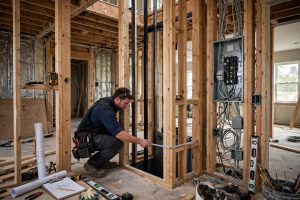
An outdoor lift is not a same-day job. A realistic sequence looks like this: in-home assessment and measurements, written quote, permit application if required, equipment order, concrete pad pour with cure time, electrical work, lift installation, inspection, and a hands-on walkthrough with the user. Plan on a few weeks from deposit to first ride, with the pad cure and permit review being the least flexible parts.
Indoor lifts skip the pad and move faster.
Mistakes That Cost People Money
Measuring the steps instead of the rise. Step count means nothing. Total vertical distance from finished grade to finished landing is the number that matters.
Ordering online without a site visit. A lift priced at the low end of the range plus an unquoted concrete pad, electrical run, and permit ends up costing more than a turnkey installation, and you own the code compliance risk.
Choosing indoor-rated equipment for a New England exterior. It will work for a season and then it will not.
Ignoring the second exit. Code and common sense both want a usable set of stairs alongside the lift for other members of the household and for anyone helping in an emergency.
Skipping annual service. These are mechanical units with batteries, safety edges, and interlocks. Yearly service is what keeps them running in year eight.
Frequently Asked Questions
What is a wheelchair lift for a home called?
A vertical platform lift, or VPL. You will also see porch lift, platform lift, and wheelchair elevator used for the same product.
How much does a home wheelchair lift cost?
Most residential installations land between roughly $4,000 and $12,000, driven by rise height, indoor or outdoor placement, and how much site prep the location needs.
How high can a residential wheelchair lift go?
Residential units commonly serve rises from about 4 feet up to 12 or 14 feet, depending on the model and configuration.
Is a wheelchair lift cheaper than a ramp?
Above roughly 30 inches of rise, usually yes. A ramp needs about a foot of length per inch of rise, so tall entrances demand long ramps with landings, and the material and labor add up fast. Below that, a ramp is typically the cheaper answer.
Do I need a permit for a wheelchair lift in New Hampshire?
It depends on your municipality. Requirements and inspection rules vary town to town, so confirm with your local building department or work with a dealer who handles permitting.
Can a wheelchair lift be installed outside in winter conditions?
Yes, using equipment built for exterior use with weather-sealed components and proper drainage. Battery backup is worth adding for outage protection.
Does Medicare pay for a wheelchair lift?
No. Medicare classifies lifts and ramps as home modifications rather than durable medical equipment. VA benefits, Medicaid waivers, USDA programs, and financing are the practical routes.
How long does installation take?
Indoor lifts can go in quickly. Outdoor installations typically run a few weeks once you account for permitting, the concrete pad and its cure time, and any electrical work.
Get the Rise Measured and the Quote in Writing
Every number in this guide becomes exact once someone measures your actual entrance. Stair Lifts & Ramps of New England is a family-owned company serving homeowners across New Hampshire from Salem and the Lakes Region, and the in-home assessment is free with no obligation.
Call 603-893-1523 or book your free in-home assessment to get exact measurements, a turnkey written quote with site prep included, and a clear answer on which funding programs you qualify for.