Choosing between a stairlift and a home elevator depends on more than price. A stairlift is generally simpler and less expensive when one person needs help traveling between floors. A home elevator provides broader floor-to-floor accessibility and may accommodate a wheelchair, multiple passengers, or household items. The right choice depends on mobility needs, staircase layout, available space, budget, and long-term plans.
What Is the Difference Between a Home Elevator and a Stairlift?
What Is a Stairlift?
A stairlift is a motorized seat mounted to a rail along a staircase. The user sits in the chair and travels between floors without walking up or down the stairs.
Stairlifts are available for straight and curved staircases, with some models designed for outdoor use. They typically require substantially less construction than a residential elevator because the equipment uses the existing staircase.
For someone who can transfer safely onto a seat and primarily needs individual access between floors, a stairlift can be a practical home accessibility solution.
What Is a Home Elevator?
A home elevator is a vertical transportation system designed to move people between floors. Depending on the model and cabin dimensions, it can provide wheelchair access and accommodate more than one passenger.
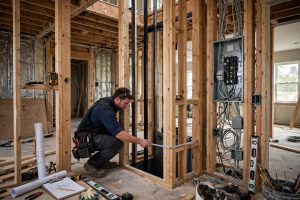
Unlike a stairlift, an elevator requires dedicated space and more extensive planning. Installation may involve structural preparation, electrical work, an enclosure or shaft, and other site-specific modifications.
Home Elevator vs Stairlift at a Glance
| Factor | Stairlift | Home Elevator |
|---|---|---|
| Primary purpose | Individual stair access | Floor-to-floor accessibility |
| Wheelchair access | Usually requires transfer | Many models can accommodate wheelchairs |
| Installation | Generally simpler | More complex |
| Space requirements | Uses existing staircase | Requires dedicated space |
| Cost | Generally lower | Generally higher |
| Multiple users | Limited | Better suited |
| Moving items | Limited | More practical |
| Long-term accessibility | Good for stair access | Broader accessibility |
Home Elevator vs Stairlift Cost
Cost is one of the biggest differences between these two options, but equipment price alone does not tell the full story.
How Much Does a Stairlift Cost?
A straight stairlift is generally the less expensive option, while curved stairlifts tend to cost more because the rail must be configured for the specific staircase.
As a general planning estimate, a stairlift may fall somewhere around $3,000–$8,000 installed, while a more complex curved system can potentially reach $8,000–$15,000 or more depending on configuration and features.
These are broad estimates, not guaranteed prices. Actual stairlift costs vary by manufacturer, staircase, installation requirements, location, features, warranty, and whether the equipment is new or refurbished.
How Much Does a Home Elevator Cost?
A residential elevator typically represents a substantially larger investment. Depending on the system, number of floors, construction requirements, electrical work, shaft or enclosure, customization, and installation complexity, a home elevator can commonly reach tens of thousands of dollars.
A rough planning range may be $30,000–$60,000+ installed, but this should not be treated as a universal price.
Pricing disclaimer: The dollar ranges in this article are general planning estimates only and are not quotes or current prices from a specific provider. Actual costs can vary considerably. A professional home assessment and written estimate are the best way to determine the cost for a particular home.
Why Is a Home Elevator More Expensive Than a Stairlift?
An elevator involves considerably more equipment and installation planning. Depending on the system, costs can include the elevator itself, structural preparation, electrical work, doors, enclosure or shaft construction, controls, safety systems, installation, and ongoing maintenance.
A stairlift generally works along an existing staircase, which can significantly reduce construction requirements.
Which Has the Lower Long-Term Cost?
A stairlift usually has the lower initial cost. However, the better long-term value depends on how long the equipment will be needed and whether accessibility requirements may change.
If a household eventually needs wheelchair access or transportation between several floors, replacing a stairlift with another accessibility system could increase the overall cost.
Home Elevator vs Stairlift for Different Accessibility Needs
Best Option for Someone Who Can Walk but Has Difficulty With Stairs
A stairlift may be sufficient when the primary problem is safely traveling up and down one staircase.
The user generally transfers onto the stairlift seat, secures the safety belt, and rides between floors.
Best Option for Wheelchair Users
A home elevator may provide a broader solution when remaining in a wheelchair during floor-to-floor travel is important.
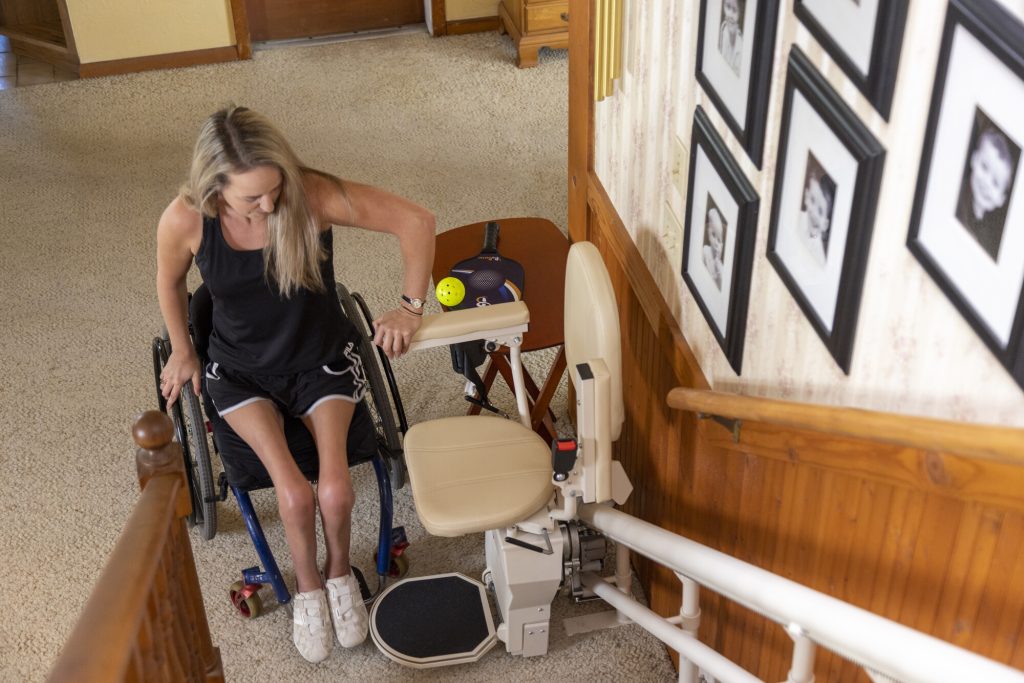
A conventional stairlift generally requires the user to transfer from the wheelchair to the stairlift seat. That transfer may not be practical for everyone.
The correct solution depends on wheelchair dimensions, elevator or lift dimensions, home layout, and the user’s specific accessibility requirements.
Best Option for Multiple People
A home elevator is generally more practical when several household members may use the system. It can potentially transport multiple passengers, depending on its rated capacity and configuration.
Best Option for Moving Groceries, Laundry and Household Items
Stairlifts are primarily designed around individual passenger transportation. An elevator can provide more practical floor-to-floor transportation for groceries, laundry, luggage, and other household items, subject to its capacity.
Best Option for Aging in Place
If the goal is long-term aging in place, consider not only what is needed today but what may be needed later.
A stairlift can provide excellent access for an individual who can transfer safely. A home elevator may offer greater flexibility if future wheelchair use, multiple users, or access to several floors is a consideration.
Stairlift vs Home Elevator for Different Types of Homes
Two-Story Homes
Both solutions can work in a two-story home. A stairlift is often easier to install, while an elevator may provide broader accessibility.
Homes With Narrow Staircases
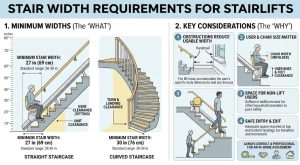
Staircase width and available clearance are important. A professional assessment can determine whether a particular stairlift configuration will work safely.
Homes With Multiple Floors
For a home with several levels, installing multiple stairlifts may become less practical than a properly planned elevator or other vertical accessibility solution.
Homes With Limited Floor Space
A stairlift often has an advantage when floor space and construction are major constraints because it uses the existing staircase.
Existing Homes vs. New Construction
Stairlifts can often be installed in existing homes with relatively little structural disruption. A home elevator can also be installed in an existing property, but planning is generally easier when elevator space is incorporated during new construction or a major renovation.
Home Elevator vs Stairlift: Pros and Cons
Advantages of a Stairlift
- Lower initial investment in many cases
- Generally simpler installation
- Uses the existing staircase
- Less construction
- Suitable for individual stair access
- Straight models can often be installed relatively quickly
Disadvantages of a Stairlift
- The user generally needs to transfer onto the seat
- The rail and chair occupy the staircase
- Limited ability to transport large household items
- Curved systems can become considerably more expensive
- Does not provide the same whole-home accessibility as an elevator
Advantages of a Home Elevator
- Can provide wheelchair access with suitable models
- Multiple passengers may be able to travel together
- More practical for transporting household items
- Provides direct floor-to-floor access
- Can be a strong long-term accessibility solution
- Can be integrated into a home’s design
Disadvantages of a Home Elevator
- Higher initial investment
- More installation planning
- Greater space requirements
- Construction may be necessary
- More complex maintenance
Home Elevator vs Stairlift Installation
How Is a Stairlift Installed?
The process generally includes a home assessment, staircase measurement, equipment selection, rail installation, testing, and user instruction.
Because the rail follows the staircase, installation is typically much less disruptive than constructing an elevator system.
How Is a Home Elevator Installed?
A home elevator installation can involve site assessment, space planning, equipment selection, structural preparation, electrical requirements, elevator installation, testing, and commissioning.
The exact process varies substantially by elevator type and home.
Which Is Less Disruptive to Install?
A stairlift is generally the less disruptive option. A home elevator can require significantly more planning and construction, particularly when the home was not originally designed to accommodate one.
Home Elevator vs Stairlift Space Requirements
How Much Space Does a Stairlift Need?
A stairlift needs adequate staircase width, seat clearance, landing space, and room for the chair and rail. Foldable seats and footrests can help preserve usable staircase space when the lift is not being used.
How Much Space Does a Home Elevator Need?
An elevator requires space for the cabin or platform, doors, vertical travel, and equipment. Depending on the system, a shaft, enclosure, machine space, or other installation components may also be necessary.
Which Is Better for a Small Home?
When space is limited, a stairlift often has the advantage because it can use an existing staircase without requiring a dedicated elevator footprint.
Home Elevator vs Stairlift Safety and Usability
Stairlift Safety Features
Common features may include:
- Seat belts
- Swivel seats
- Obstacle sensors
- Safety sensors
- Battery backup
- Locking mechanisms
Home Elevator Safety Features
Depending on the system, elevators may include door interlocks, emergency controls, safety sensors, emergency backup systems, and emergency lowering or opening functions.
Always review the manufacturer’s safety specifications and have equipment professionally installed and serviced.
Which Is Easier to Use?
A stairlift can be straightforward for an individual who can safely transfer onto the seat. A home elevator may be easier for wheelchair users or households where several people need floor-to-floor access.
How to Choose Between a Home Elevator and Stairlift
Step 1: Identify Who Needs the Accessibility Equipment
Determine whether the equipment is for one person, several household members, a wheelchair user, or someone using a walker or cane.
Step 2: Determine Whether a Transfer Is Practical
Consider whether the intended user can safely transfer from a wheelchair or standing position onto a stairlift seat.
Step 3: Evaluate the Staircase
Check whether the staircase is straight or curved, its width, number of flights, landings, and available clearance.
Step 4: Evaluate Available Space for an Elevator
Determine whether your home has sufficient space for the elevator cabin, doors, vertical travel, and installation requirements.
Step 5: Establish Your Budget
Compare the complete installed cost rather than looking only at equipment prices.
Step 6: Consider Long-Term Accessibility Needs
Ask whether the solution is temporary, whether accessibility needs could change, and whether wheelchair access or multiple users may become important.
Step 7: Get a Professional Home Assessment
A qualified accessibility professional can evaluate the staircase, home layout, equipment requirements, and installation considerations.
Step 8: Compare Written Quotes
Compare equipment, installation, structural work, electrical work, warranty, maintenance, service, and optional features.
Home Elevator vs Stairlift Comparison Table
| Feature | Stairlift | Home Elevator |
|---|---|---|
| Initial investment | Generally lower | Generally higher |
| Installation complexity | Lower | Higher |
| Uses existing staircase | Yes | No |
| Wheelchair accessibility | Usually requires transfer | Often possible |
| Multiple passengers | Limited | Better suited |
| Carrying household items | Limited | Better suited |
| Space requirements | Lower | Higher |
| Construction | Usually minimal | May be substantial |
| Straight configuration | Available | Available depending on system |
| Curved configuration | Available | Not comparable |
| Long-term whole-home access | Moderate | Strong |
| Best for | Individual stair access | Broad floor-to-floor accessibility |
Exact capabilities vary by equipment model, home layout, installation requirements, and manufacturer specifications.
When Is a Stairlift Better Than a Home Elevator?
Choose a Stairlift When You Need a Simpler Solution
A stairlift can be the practical choice when one person primarily needs help navigating an existing staircase.
Choose a Stairlift When Budget Is a Major Consideration
The lower installation complexity and equipment cost can make a stairlift more accessible for households working with a smaller budget.
Choose a Stairlift When Construction Needs to Be Minimal
If major remodeling is undesirable, using the existing staircase can significantly simplify the project.
Choose a Stairlift When One Person Needs Stair Access
A stairlift is specifically designed around individual stair travel.
Choose a Stairlift When the Home Cannot Easily Accommodate an Elevator
Limited floor space, structural constraints, or the home’s existing layout may make an elevator impractical.
When Is a Home Elevator Better Than a Stairlift?
Choose a Home Elevator for Wheelchair Accessibility
A suitable residential elevator can allow a wheelchair user to travel between floors without transferring to a stairlift chair.
Choose a Home Elevator for Multiple Users
Elevators can be better suited to couples, families, caregivers, and other households where multiple people need floor-to-floor access.
Choose a Home Elevator for Multiple Floors
A single elevator can potentially provide access to several levels, depending on the system and installation.
Choose a Home Elevator for Long-Term Aging in Place
When planning for broader future accessibility needs, an elevator can provide more flexibility than an individual stairlift.
Choose a Home Elevator When Moving Items Between Floors Matters
The larger cabin or platform can make transporting household items more practical.
What Questions Should You Ask Before Choosing?
Before committing to either solution, ask:
- Who will use the equipment?
- Can the user safely transfer?
- Is wheelchair access required?
- How many floors need access?
- How wide is the staircase?
- How much space is available?
- What is the total installed cost?
- What maintenance is required?
- What warranty is included?
- How quickly can it be installed?
- What happens if the equipment breaks?
- Will the solution meet potential future accessibility needs?
Home Elevator vs Stairlift FAQs
Is a home elevator better than a stairlift?
Neither is universally better. A stairlift is often better for simpler individual stair access, while a home elevator may be better for wheelchair accessibility, multiple users, multiple floors, and broader long-term accessibility.
Is a stairlift cheaper than a home elevator?
Generally, yes. Stairlifts usually require less equipment, space, and construction, resulting in a lower initial investment in many homes.
Can a wheelchair user use a stairlift?
A conventional stairlift generally requires transferring from the wheelchair onto the stairlift seat. Depending on the user’s needs, a residential elevator or another accessibility lift may provide a more suitable solution.
How much does a home elevator cost compared with a stairlift?
A home elevator generally costs substantially more because of equipment, installation, structural preparation, electrical work, and space requirements. Actual pricing requires a home-specific assessment.
Which is better for aging in place, a stairlift or home elevator?
It depends on current and anticipated needs. A stairlift may be ideal for individual stair access, while an elevator can provide broader accessibility if wheelchair use, multiple users, or multiple floors are concerns.
Does a stairlift take up a lot of space?
A stairlift uses the existing staircase, but the rail, seat, footrest, and folded components still require adequate clearance. Staircase measurements should be checked before installation.
Can you install a home elevator in an existing house?
Yes, residential elevators can be installed in some existing homes. Feasibility depends on available space, structure, access between floors, elevator specifications, and installation requirements.
Which is easier to install, a stairlift or home elevator?
A stairlift is generally easier and less disruptive to install because it follows the existing staircase. A home elevator typically requires substantially more planning and installation work.
Should I get a stairlift or home elevator for long-term accessibility?
Consider whether the user may eventually need wheelchair access, whether multiple people will use the equipment, how many floors require access, and the total long-term cost. A professional assessment can help determine which option fits the home.
Conclusion — Home Elevator vs Stairlift: Which Should You Choose?
The best choice between a home elevator and stairlift depends on the accessibility problem you are trying to solve.
A stairlift is generally the better fit when one person needs a simpler, lower-cost way to travel up and down an existing staircase. A home elevator can be the stronger long-term solution when wheelchair access, multiple users, multiple floors, or transportation of household items are important.
Don’t compare equipment prices alone. Consider installation, construction, maintenance, available space, staircase configuration, and future accessibility needs.
The best next step is a professional home assessment. A qualified accessibility provider can evaluate your home and recommend the equipment that fits your staircase, mobility requirements, and long-term plans.